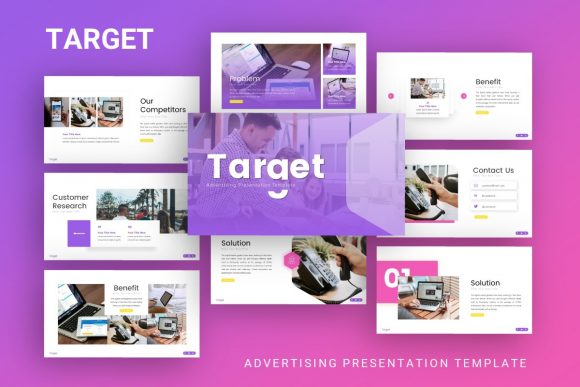
Presentation Template - Target: Integrating Strategic Visuals into Professional Workflows
Effective communication is the backbone of any successful project, whether you are launching a startup, pitching a creative campaign, or documenting corporate progress. The Presentation Template - Target serves as more than just a collection of slides; it functions as a structural framework for organizing complex information into a compelling narrative. For professionals aged 20 to 50, time is often the most constrained resource. This template bridges the gap between raw data and persuasive storytelling by providing a pre-engineered visual system that maintains brand consistency while reducing design friction.
In a broader workflow context, this asset acts as a standardization tool. Rather than building decks from scratch for every meeting or proposal, teams can utilize the 35 included slides as modular components. This shifts the focus from formatting and alignment to content strategy and message refinement. By integrating Presentation Template - Target into your operational routine, you establish a baseline of quality that ensures every output looks professional, regardless of who on the team creates it.
Strategic Application Across Project Phases
The utility of a comprehensive presentation asset extends across the entire lifecycle of a business initiative. Understanding where and how to deploy these resources maximizes their return on investment.
Pre-Project Planning and Pitching
During the conceptual phase, clarity is paramount. When preparing a pitch deck for investors or a proposal for a new client, the structure of your presentation dictates the flow of your argument. The handcrafted infographics within this template allow you to visualize business models, market analysis, and financial projections before finalizing the underlying data. This "design-first" approach can actually aid in thinking; seeing a placeholder for a specific metric often prompts teams to identify gaps in their research or strategy. For startups and agencies, using the dedicated pitch deck layouts helps ensure that critical value propositions are highlighted effectively during initial discussions.
Execution and Internal Alignment
Once a project is underway, communication needs shift toward status updates, sprint reviews, and team alignment. The corporate and business slides included in Presentation Template - Target are designed for high-frequency use. Because the master slides are fully editable, project managers can create a standardized reporting format that stakeholders recognize instantly. This reduces cognitive load during meetings; attendees know exactly where to look for KPIs, timelines, and risk assessments. The ability to drag and drop images and resize graphics without breaking the layout ensures that internal documentation remains clean and readable, even when produced under tight deadlines.
Post-Project Review and Portfolio Building
After delivery, the work transitions into case studies and portfolio pieces. Creatives, photographers, and freelancers can repurpose the same template used for the initial pitch to showcase final results. The photography and portfolio-specific layouts provide elegant grids and typography hierarchies suitable for displaying visual work. This continuity creates a cohesive brand experience for prospective clients reviewing your past performance. Furthermore, educators and trainers can adapt these post-project summaries into learning materials, turning real-world experiences into structured educational content.
Technical Integration and Tool Compatibility
A template is only as effective as its compatibility with existing tech stacks. Presentation Template - Target is built natively in PowerPoint (.PPTX), ensuring seamless integration with Microsoft 365 environments. This native foundation is critical for collaborative workflows where multiple stakeholders must edit a single file. Unlike third-party design tools that may require specialized licenses or training, PPTX files remain universally accessible in corporate settings.
The inclusion of vector icons and resizable graphics addresses a common pain point in cross-platform collaboration. Vector assets scale infinitely without pixelation, meaning the deck looks crisp whether projected on a conference room screen or viewed on a mobile device. When integrating with other resources, such as Excel charts or external image libraries, the picture placeholders act as safe containers. Users can import data visualization directly from analytics platforms, and the master slide logic preserves the intended aesthetic. This interoperability prevents the "broken slide" syndrome that often occurs when moving assets between different software ecosystems.
Optimizing Workflow Efficiency and Consistency
Adopting a standardized template is an exercise in operational efficiency. The primary advantage lies in the Master Slide architecture. Changes made to a master element—such as a logo position, font style, or color palette—propagate instantly across all 35 slides. This feature is indispensable for maintaining brand integrity across large organizations or multi-client agencies.
- Reduced Revision Cycles: By locking down design parameters, you eliminate subjective debates about font sizes or spacing during review meetings. Feedback focuses on substance rather than style.
- Faster Onboarding: New team members can produce on-brand presentations immediately without needing extensive design training or reading lengthy brand guidelines.
- Asset Management: With all graphic elements contained within the file and documented in the included documentation file, teams avoid the chaos of hunting for missing fonts or broken image links.
For productivity-minded users, this template serves as a constraint that fosters creativity. Limitless blank canvases often lead to decision fatigue. A structured set of 35 curated layouts provides boundaries that accelerate decision-making, allowing you to select the most appropriate format for your data rather than inventing one from zero.
Practical Implementation Guidelines
To integrate Presentation Template - Target smoothly into your routine, treat it as a living system rather than a static file. Begin by customizing the master slides to reflect your current branding before creating individual decks. Save this customized version as a read-only template file (.potx) to prevent accidental overwrites of your core design system.
When working with the handcrafted infographics, prioritize data accuracy over decorative complexity. While the illustrations are pixel-perfect, they should serve the narrative. If a specific chart type does not accurately represent your data, utilize the vector icon library to build a custom visualization that adheres to the template’s visual language. Always refer to the included documentation file for specific instructions on editing complex grouped elements; understanding the layer structure prevents frustration during late-night edits.
Be mindful of licensing and asset management. As noted in the product specifications, demo images are for preview purposes only. Establish a workflow for sourcing and licensing your own photography to replace placeholders. Maintaining a centralized folder of approved, licensed imagery that matches the template’s aesthetic will further streamline the creation process. This preparation ensures that the final output is not only visually consistent but also legally compliant and ready for public distribution.
Quality Control and Long-Term Maintenance
Sustaining the value of this template requires periodic maintenance. As your organization evolves, so should your presentation assets. Schedule quarterly reviews of your master template to update contact information, refresh color palettes, or retire outdated slide layouts. This practice prevents the accumulation of legacy elements that no longer serve your current strategic goals.
Quality control also involves checking accessibility standards. Ensure that text contrast ratios meet WCAG guidelines and that alt-text is applied to images and infographics. The editable nature of Presentation Template - Target makes it easy to remediate accessibility issues globally via master slides, ensuring your communications are inclusive for all audience members.
Ultimately, the goal of utilizing a professional presentation asset is to reduce the friction between having an idea and sharing it effectively. By embedding Presentation Template - Target into your planning, execution, and review processes, you create a reliable infrastructure for communication. This allows professionals, creators, and entrepreneurs to spend less time wrestling with software and more time refining the strategies that drive their success. The template handles the visual heavy lifting, ensuring that your message lands with the precision and impact it deserves.