Presentation Template - Jellyfish: Integrating Visual Storytelling into Professional Workflows
In the modern professional landscape, the speed at which you can translate abstract concepts into compelling visual narratives often determines project momentum. Presentation Template - Jellyfish serves as more than a collection of aesthetically pleasing slides; it functions as a structural framework for communication across diverse disciplines. Whether you are managing a creative agency, launching a startup, or documenting a personal portfolio, this template system bridges the gap between raw data and persuasive storytelling. By understanding where this asset fits within your broader operational workflow, you can reduce production time while maintaining high standards of visual consistency and brand integrity.
Strategic Positioning in the Project Lifecycle
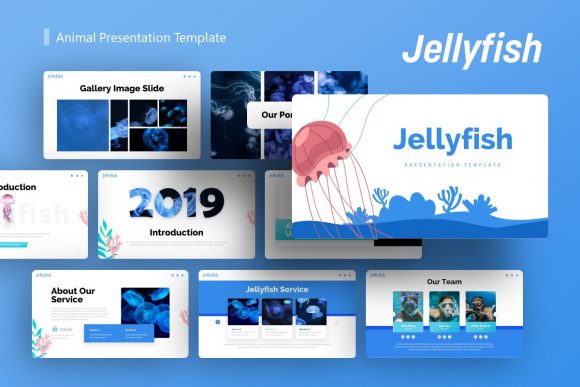
Effective presentation design is rarely an isolated task. It intersects with planning, execution, and review phases of almost any professional endeavor. Introducing Jellyfish Animal Presentation into your workflow requires recognizing its utility at different stages of a project. Before a project begins, the template acts as a planning scaffold. The 36 included slides provide predefined containers for information, forcing presenters to organize their thoughts logically before getting lost in design minutiae. This pre-structuring phase is critical for pitch decks and corporate profiles where narrative flow dictates stakeholder buy-in.
During the active execution phase, such as a marketing campaign or a photography showcase, the template serves as a dynamic reporting tool. Because the content is easily customizable and based on Master Slides, teams can update progress reports or portfolio pieces without rebuilding layouts from scratch. This agility is essential for freelancers and small business owners who must pivot quickly based on client feedback or market changes. Post-project, the template facilitates retrospective analysis and case study creation. The handcrafted infographics allow for the clear visualization of outcomes, turning complex metrics into digestible insights that can be repurposed for future business development or educational content.
Versatility Across Professional Domains
The adaptability of Presentation Template - Jellyfish stems from its neutral yet sophisticated design language. While the name suggests a specific theme, the underlying structure supports a wide array of professional use cases. For creative agencies and photographers, the picture placeholders and pixel-perfect illustrations offer a gallery-ready aesthetic that highlights visual work without competing with it. The drag-and-drop functionality ensures that high-resolution imagery can be integrated seamlessly, maintaining aspect ratios and alignment automatically.
Conversely, for corporate entities, startups, and educators, the value lies in the data visualization capabilities. Business workflows often require translating dense financial models or operational strategies into accessible formats. The included vector icons and editable graphics allow professionals to construct custom diagrams that align with specific industry terminology. This duality makes the template a viable asset for mixed-use environments, such as incubators or co-working spaces, where users range from artists to fintech founders. Personal portfolios also benefit from this versatility, allowing individuals to present their career trajectory with the same level of polish expected from established corporations.
Technical Integration and Asset Management
Integrating a new template into an existing tech stack requires attention to compatibility and file management. Presentation Template - Jellyfish is delivered as a PowerPoint .PPTX file, ensuring broad compatibility across Microsoft Office ecosystems and third-party presentation software. However, maximizing efficiency involves more than simply opening the file. Professionals should treat the template as a master asset library rather than a disposable document.
The inclusion of a Documentation File is a critical component for long-term usability. Before beginning customization, users should review this guide to understand the hierarchy of Master Slides. Editing at the Master Slide level propagates changes across multiple layouts, significantly reducing repetitive tasks. Furthermore, the vector icon set should be extracted and cataloged within your organization’s digital asset management system. This ensures that the visual language established by the Jellyfish template remains consistent even when creating ad-hoc documents or emails outside of the primary presentation deck. Understanding that demo images are for preview purposes only prevents workflow bottlenecks; teams must have their own licensed imagery ready to populate the placeholders immediately upon deployment.
Optimizing Workflow Efficiency and Consistency
One of the primary friction points in presentation design is the inconsistency that arises when multiple team members contribute to a single deck. Presentation Template - Jellyfish mitigates this risk through its standardized layout architecture. When used as part of a collaborative workflow, it establishes guardrails that maintain quality control. Team members can focus on content accuracy and strategic messaging, trusting that the visual formatting adheres to professional standards.
For productivity-minded users, the "easy customizable contents" feature translates directly to time savings. Instead of adjusting text boxes and realigning shapes for every new slide, users leverage pre-built smart objects. This is particularly valuable during high-pressure periods, such as pre-launch preparations or end-of-quarter reporting. The resizable and editable nature of all graphics means that assets created for one project can be adapted for another, creating a compounding return on investment. Over time, this builds a proprietary library of customized slides that accelerates future production cycles.
Practical Implementation Strategies
To fully realize the potential of this template, users should adopt a process-oriented approach to customization. Begin by auditing the 36 available slides against your specific communication goals. Not every slide will be relevant for every project. Curate a subset of layouts that best serve your immediate needs—such as the infographic slides for data-heavy reports or the image-centric slides for creative pitches—and hide or delete unused masters to keep the working file lightweight and organized.
When populating the template, prioritize semantic alignment between text and visuals. The handcrafted infographics are designed to convey specific types of relationships, such as timelines, hierarchies, or comparisons. Selecting the appropriate graphic structure enhances cognitive processing for the audience. Avoid forcing content into incompatible layouts; instead, utilize the editable vector elements to modify the infographic to match your data precisely. This attention to detail distinguishes a professional deliverable from a generic template application.
Collaboration protocols should also be defined early. If multiple stakeholders are editing the deck, establish naming conventions for custom slides and color codes for status tracking within the presentation notes. Since the template relies on Master Slides for global consistency, restrict direct formatting overrides on individual slides unless absolutely necessary. This discipline preserves the integrity of the design system and ensures that future updates to the master template apply correctly across the entire document.
Long-Term Value and Scalability
Investment in a premium presentation asset like Presentation Template - Jellyfish should be evaluated through the lens of scalability. For freelancers and solopreneurs, the template provides an instant upgrade to personal branding, signaling professionalism to prospective clients without the cost of custom design services. For growing companies, it serves as a transitional brand asset that maintains coherence until a bespoke identity system is developed. Even after a rebrand, the structural logic and layout principles embedded in the template remain valuable references for internal communications and training materials.
The educational sector also finds lasting utility in this resource. Educators and trainers can adapt the visual frameworks to create modular course materials that are engaging and easy to update semester after semester. The ability to resize and edit all graphics ensures that content remains current without requiring advanced design skills. Ultimately, the template functions as a productivity multiplier. By systematizing the visual aspect of communication, professionals free up mental bandwidth to focus on strategy, creativity, and relationship building. The result is not just a better-looking presentation, but a more efficient and effective communication process that supports sustained professional growth.
Ensuring Quality Control in Deliverables
While templates accelerate production, they do not replace the need for rigorous quality assurance. Users of Introducing Jellyfish Animal Presentation must implement a final review checklist specific to the template’s features. Verify that all placeholder images have been replaced with high-resolution, properly licensed assets. Check that resized graphics have maintained their proportions and that text remains legible against background elements. Ensure that hyperlinks and interactive elements function correctly in the intended presentation environment, whether that be a live Zoom call, an embedded web player, or a projected conference hall screen.
Consistency checks should extend beyond the slide deck itself. If the presentation is accompanied by handouts, whitepapers, or email summaries, ensure those collateral materials reflect the same visual tone. The vector icons included with the template are excellent resources for maintaining this cross-channel cohesion. By treating the template as a comprehensive design system rather than a mere backdrop, professionals ensure that every touchpoint reinforces their message and brand identity. This holistic approach to implementation transforms a standard file download into a strategic asset that enhances clarity, engagement, and professional credibility across all forms of visual communication.