Evaluating Presentation Template - Medicating for Mental Health and Professional Communication
Selecting the right visual framework for sensitive topics requires balancing aesthetic appeal with functional clarity. When addressing mental health, medication management, or clinical education, the design must convey trust and professionalism without appearing sterile or overly commercial. The Presentation Template - Medicating serves as a specialized resource designed to bridge this gap. While originally crafted with healthcare and pharmaceutical contexts in mind, its structural flexibility allows it to function effectively across creative agencies, corporate profiles, startups, and personal portfolios. Understanding where this template fits within the broader ecosystem of presentation tools is essential for professionals aged 20 to 50 who are evaluating resources for their next project.
Defining the Scope and Utility of Presentation Template - Medicating
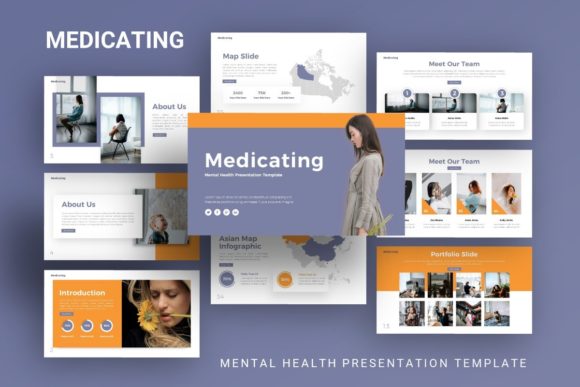
At its core, Presentation Template - Medicating is a comprehensive slide deck system comprising 35 unique slides built on PowerPoint Master Slides. This technical foundation distinguishes it from basic thematic templates that merely apply color filters to standard layouts. By utilizing master slides, global changes to typography, color palettes, and logo placement propagate instantly throughout the entire deck, significantly reducing formatting time during the revision process. The inclusion of handcrafted infographics specifically tailored for data visualization makes it particularly relevant for users who need to explain complex processes, such as treatment plans, statistical outcomes, or organizational workflows.
The template’s versatility extends beyond medical applications. Because the graphics are vector-based and fully editable, users can repurpose the clean, structured layouts for business pitch decks, photography portfolios, or company profiles. For example, a startup founder might use the timeline infographics to illustrate product development milestones rather than patient care pathways. Similarly, a creative agency could adapt the picture placeholders to showcase campaign visuals while maintaining a cohesive grid system. This adaptability suggests that the template is less about rigid industry categorization and more about providing a robust architectural framework for information design.
Comparing Specialized Templates Versus Generic Alternatives
When researching presentation options, buyers typically encounter three categories: generic multipurpose themes, niche-specific medical templates, and custom-designed solutions. Presentation Template - Medicating occupies a middle ground that offers distinct tradeoffs compared to these alternatives.
Generic multipurpose templates often provide hundreds of slides but lack cohesive narrative flow for specific subjects. They may offer a "medical" section, but it is frequently superficial, consisting of stock photos of doctors rather than functional diagrams for explaining concepts. In contrast, Presentation Template - Medicating provides depth over breadth. With 35 focused slides, it prioritizes usability for detailed explanations over sheer volume. For a user preparing a 20-minute talk on mental health awareness or a corporate wellness initiative, this focus prevents the paralysis of choice often associated with massive generic libraries.
Conversely, highly specialized clinical templates can sometimes feel too academic or outdated for modern business or creative contexts. They may rely on dense text blocks or legacy clip art that undermines a contemporary brand identity. Presentation Template - Medicating mitigates this risk through pixel-perfect illustrations and resizable vector graphics. This ensures the visual language remains crisp on high-definition displays and adaptable to different aspect ratios. However, users seeking hyper-specific anatomical accuracy or regulatory-compliant medical disclaimers pre-built into the slides may find this template too generalized. It is a communication tool, not a clinical reference library.
Custom design remains the gold standard for unique branding but comes with significant cost and time investments. For freelancers, small agencies, or internal teams with limited design budgets, Presentation Template - Medicating offers a pragmatic compromise. It delivers professional polish at a fraction of the cost of bespoke design, provided the user is comfortable working within PowerPoint’s native environment.
Technical Considerations and Workflow Integration
Evaluation should also consider technical compatibility and asset management. The template includes a .PPTX file, documentation, and vector icons. The presence of documentation is a critical differentiator; many marketplace templates assume user expertise, leading to frustration when modifying master elements. Clear instructions ensure that non-designers can leverage the template’s full potential without breaking the layout structure.
It is important to note that demo images are for preview purposes only and are not included in the download. This is standard industry practice, but it impacts project timelines. Users must have access to their own licensed imagery or stock photo subscriptions. For mental health presentations, this actually serves as a safeguard, encouraging the selection of authentic, ethically sourced visuals rather than relying on potentially insensitive placeholder content. The drag-and-drop picture placeholders streamline this integration, allowing users to test multiple image options quickly to find the most appropriate tone.
Assessing Fit: When to Choose This Resource
Determining whether Presentation Template - Medicating is the correct solution depends on specific project parameters and audience expectations. It is particularly well-suited for scenarios requiring a blend of empathy and authority.
- Mental Health Advocacy and Education: Non-profits and educators discussing medication adherence, therapy options, or destigmatization campaigns benefit from the template’s balanced aesthetic. It avoids the alarmist reds often found in emergency medicine templates and the overly playful tones of general wellness designs.
- Healthcare Tech Startups: Companies pitching digital health solutions, teletherapy platforms, or pharmacy management software need to demonstrate both technological sophistication and human-centric care. The infographic capabilities allow for clear explanation of app interfaces or service models.
- Corporate Wellness Programs: HR departments presenting benefits packages or EAP (Employee Assistance Program) resources require materials that look professional yet approachable. The clean lines and ample whitespace support readability without feeling clinical.
- Creative Portfolios with Narrative Focus: Photographers or designers whose work involves documentary storytelling, social issues, or portraiture may find the structured layouts helpful for sequencing visual narratives coherently.
Situations Requiring Alternative Solutions
Despite its strengths, this template is not universally applicable. Recognizing limitations is as important as identifying benefits.
- Data-Heavy Financial Reporting: If the primary goal is displaying complex quarterly earnings, multi-variable regression charts, or dense financial tables, a finance-specific template with pre-built Excel-linked charts would be more efficient. The infographics here are conceptual rather than analytical.
- Purely Clinical Training: Medical students or surgeons requiring anatomical precision, surgical procedure step-by-steps, or pharmacological mechanism diagrams should seek peer-reviewed educational resources. This template supports communication about medicine, not medical instruction itself.
- Video-First Content: While PowerPoint supports animation, users creating video essays or motion graphics may find After Effects or Premiere Pro templates more suitable. This resource is optimized for live presentation or static PDF distribution.
- Brand-Restricted Environments: Organizations with extremely rigid brand guidelines that prohibit any deviation from specific grid systems or typefaces may spend more time overriding master slides than building from scratch. Always audit the master slide structure against your brand book before purchasing.
Making an Informed Decision
The decision to adopt Presentation Template - Medicating should stem from a realistic assessment of content needs versus design capabilities. For adults navigating the crowded marketplace of digital assets, value lies not in the number of features but in the reduction of friction between idea and execution.
If your objective is to communicate nuanced information about mental health, introduce new protocols, or present a portfolio with a clean, empathetic aesthetic, this template provides a strong foundation. Its 35-slide structure encourages concise storytelling, while the vector-based customization ensures longevity across multiple projects. However, if your needs are strictly analytical, highly specialized clinically, or oriented toward video production, exploring category-specific alternatives will likely yield better results.
Ultimately, a template is a starting point, not a final product. The effectiveness of Presentation Template - Medicating depends heavily on the quality of content inserted into its framework. Users should view it as a professional scaffold that handles visual consistency, freeing them to focus on crafting messages that resonate authentically with their audience. By weighing the practical features against specific project requirements, professionals can select resources that genuinely enhance their communication strategy rather than simply filling a format requirement.