Strategic Visual Communication with the Commerce Presentation Template
In the modern digital landscape, the ability to convey complex business concepts through clear, compelling visuals is as critical as the data itself. Whether pitching to venture capitalists, showcasing a creative portfolio, or reporting quarterly earnings to stakeholders, the medium of delivery significantly influences message retention. The Presentation Template - Commerce serves as a comprehensive visual framework designed to bridge the gap between raw information and persuasive storytelling. This resource is not merely a collection of slides; it is a structured system for organizing narratives across diverse professional sectors, from startups and creative agencies to corporate entities and educational institutions.
Architectural Flexibility Across Diverse Sectors
One of the primary challenges in selecting presentation assets is finding a solution that adapts to specific industry nuances without requiring extensive redesign. The Introducing Commerce Business Presentation addresses this by offering an architecture that supports multiple distinct use cases. Understanding how this template functions across different domains helps users maximize its utility beyond generic business slides.
Startup Ecosystems and Pitch Decks
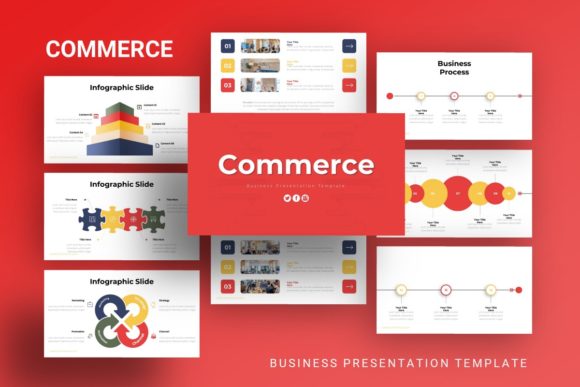
For entrepreneurs and early-stage companies, the narrative arc is often more important than the aesthetic alone. Investors typically review dozens of decks weekly, making structural clarity paramount. This template provides pre-organized flows specifically suited for pitch decks, including problem-solution matrices, market size visualization, and team introduction layouts. The inclusion of 35 unique slides allows founders to select only the components relevant to their current funding stage, avoiding the clutter that often dilutes early-stage pitches. The handcrafted infographics are particularly valuable here, as they allow for the rapid visualization of traction metrics and financial projections without the need for external graphic design support.
Creative Agencies and Portfolios
Creative professionals face a different set of requirements where visual hierarchy and negative space take precedence over dense data tables. When utilized for a Creative Agency or Personal Portfolio, the template’s pixel-perfect illustrations and resizable graphics provide a polished backdrop for showcasing work. The drag-and-drop picture placeholders streamline the process of updating case studies, allowing photographers and designers to focus on curation rather than formatting. Because the template is based on Master Slides, global changes to color palettes or typography can be applied instantly, ensuring brand consistency across a portfolio that may contain vastly different project types.
Corporate Reporting and Company Profiles
Established organizations require templates that balance professionalism with engagement. For Company Profile and Corporate Business presentations, the template offers structured layouts for organizational charts, service breakdowns, and strategic roadmaps. The vector icons included in the file package ensure that internal communications maintain a high-resolution appearance regardless of screen size or projection quality. This is essential for multinational corporations where presentations may be viewed on everything from mobile devices during transit to large-format screens in boardrooms.
Technical Specifications and Workflow Efficiency
Beyond aesthetic versatility, the practical value of any digital asset lies in its technical implementation. Users must understand the underlying mechanics of the Presentation Template - Commerce to leverage it effectively within their existing workflows. The technical features are designed to reduce friction during the creation process while maintaining professional output standards.
- Master Slide Architecture: The foundation of this template relies on Master Slides rather than individual slide formatting. This distinction is crucial for efficiency. When a user modifies a logo position, font style, or background element on the Master Slide, that change propagates across all associated slides. This eliminates the tedious task of formatting slides individually and prevents inconsistencies that often arise in collaborative editing environments.
- Vector-Based Scalability: All graphics and icons are provided in vector format. Unlike raster images which pixelate when enlarged, vector elements remain crisp at any resolution. This feature future-proofs the presentation, ensuring it looks professional whether displayed on a standard laptop or a 4K conference room display. It also allows designers to recolor elements directly within PowerPoint to match specific brand guidelines without needing Adobe Illustrator.
- Editable Infographic Systems: Data visualization is often the most time-consuming aspect of deck creation. The handcrafted infographics in this template are fully editable native PowerPoint objects, not static images. Users can modify chart values, adjust segment sizes, and update labels directly within the software. This integration removes the dependency on external design tools and accelerates the iteration cycle when data changes shortly before a presentation.
- Comprehensive Asset Library: The package includes a documentation file and a dedicated vector icon set. These supplementary files reduce the need to source third-party assets, keeping the visual language consistent. The documentation serves as a technical manual, guiding users through customization options and troubleshooting common formatting issues.
Optimizing Content Strategy Within Pre-Built Frameworks
While the Presentation Template - Commerce provides the container, the effectiveness of the final output depends on how content is mapped to the available structures. Professionals should approach this template as a modular system rather than a linear sequence. With 35 slides available for each template variation, the strategic selection of slides is key to maintaining audience engagement.
Narrative Pacing and Slide Selection
A common error in using comprehensive templates is the inclination to utilize every available slide. However, effective communication requires restraint. Users should audit the 35-slide library against their specific narrative goals. For a concise investor update, a subset of ten to twelve focused slides may be superior to a sprawling thirty-slide deck. The variety of layouts available—from full-bleed photography to split-screen data comparisons—allows presenters to control pacing. Alternating between text-heavy analytical slides and visual breathing room helps prevent cognitive overload, a principle supported by educational research on multimedia learning.
Visual Consistency and Brand Alignment
The template serves as a baseline, but it must be adapted to reflect the presenter's unique identity. The "pixel-perfect" nature of the default design ensures a high starting point, but brand alignment requires intentional customization. Utilizing the Master Slide functionality to implement corporate color codes and proprietary typefaces transforms the generic template into a branded asset. This step is vital for maintaining trust; audiences subconsciously associate visual polish with organizational competence. Furthermore, because demo images are for preview purposes only, users must invest time in sourcing or creating high-quality replacement imagery that authentically represents their subject matter. Generic stock photography can undermine the credibility of even the most well-designed template.
Considerations for Implementation and Licensing
Adopting a premium presentation template involves practical considerations regarding file management and usage rights. Understanding these factors prevents downstream issues during active projects.
File Compatibility and Version Control: While the .PPTX format is widely supported, advanced features like morph transitions or specific animation paths may behave differently across PowerPoint versions. Users working in mixed-version environments should test the template early in the production cycle. Additionally, because the template includes editable master slides, teams should establish version control protocols to prevent accidental overwrites of core design elements. Saving a locked "master copy" and working only on duplicates is a recommended best practice.
Asset Management: The note that demo images are excluded is a standard licensing practice, but it necessitates preparation. Users should have a repository of approved imagery ready before beginning customization. Relying on low-resolution placeholders during the drafting phase can lead to layout shifts when high-resolution assets are eventually inserted. Planning image dimensions and aspect ratios in advance ensures the drag-and-drop placeholders function as intended without distorting the carefully crafted grid systems.
Learning Curve vs. Time Savings: Although marketed as "easy customizable," there is an initial learning curve associated with understanding the Master Slide structure and infographic editing. First-time users should allocate time to review the included documentation file. This upfront investment pays dividends in subsequent uses, as familiarity with the template’s logic drastically reduces production time for future presentations. For teams, designating a single power user to manage template updates and train others can standardize quality and efficiency across the organization.
Evaluating Long-Term Value in Professional Toolkits
The decision to integrate the Presentation Template - Commerce into a professional toolkit should be evaluated based on long-term utility rather than single-project needs. Its value proposition extends beyond immediate time savings to include the establishment of a scalable visual system. By providing a consistent foundation for Creative Agency pitches, Corporate reports, and Personal Portfolios alike, it reduces the cognitive load associated with starting new presentations from scratch.
Furthermore, the emphasis on native PowerPoint editability ensures longevity. Templates that rely heavily on external plugins or non-standard formats often become obsolete as software updates. By adhering to standard .PPTX architecture while maximizing its advanced features, this template remains viable across software iterations. The inclusion of vector assets and modular infographics further enhances this durability, allowing the template to evolve alongside the user’s changing business needs. Ultimately, successful utilization of this resource requires viewing it not as a static product, but as a dynamic component of a broader communication strategy. When approached with strategic intent, it facilitates clearer messaging, stronger brand recognition, and more efficient content production across the varied spectrum of modern professional endeavors.